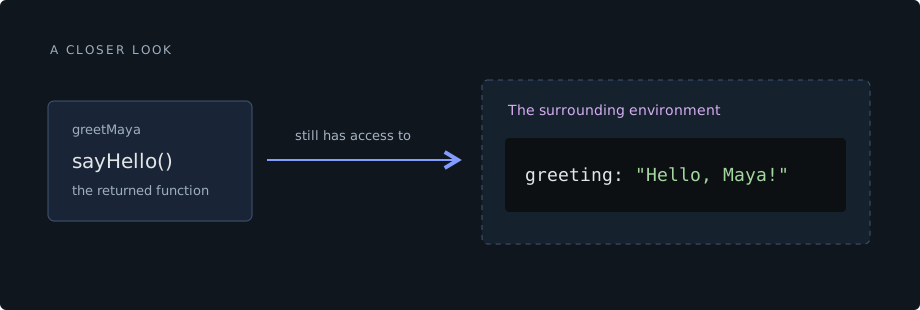
Overview
Explain this interview process in a seamless way so other people don't have to question exactly what you're doing.
- Heollo
Core Concept
Explain the foundational mental model in clear, interview-friendly language.
- Key principle to emphasize to the interviewer
- Common architectural or runtime implication
- How to reason through this under interview pressure
example.js
function processData(items) {
  // Retain access to necessary context
  const filtered = items.filter(Boolean);
  return filtered.map(item => item.value);
}

const sample = [{ value: 'A' }, null, { value: 'B' }];
console.log(processData(sample)); // ['A', 'B']Attribute | Approach A | Approach B |
|---|---|---|
Time Complexity | O(1) average lookup | O(log N) ordered traversal |
Space Overhead | Higher (hash table buckets) | Compact (contiguous nodes) |
Best Suited For | Fast cache & key-value lookups | Range queries & sorted iteration |
Think it throughWhat is the primary trade-off of this approach when scaling to thousands of concurrent users?
Memory consumption increases linearly with active closures/sessions. To mitigate this in production, ensure unused references are garbage collected and avoid retaining heavy outer scopes unnecessarily.