JavaScript is single-threaded: it has only one Call Stack and executes one piece of code at a time. Yet web applications routinely handle network requests, timers, DOM user events, and smooth animations without freezing the interface.
How does this work? Through the Event Loop—the runtime coordinator that continuously monitors the Call Stack and orchestrates work from two asynchronous queues: the Microtask Queue and the Macrotask Queue.
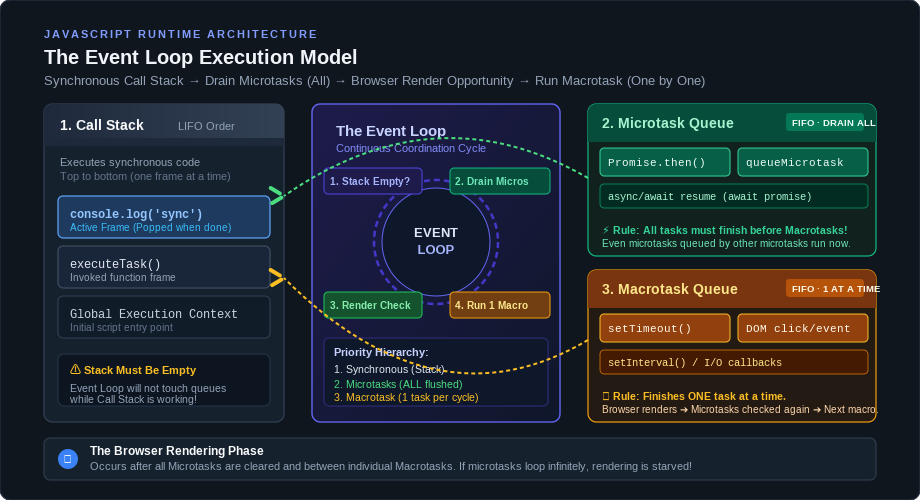
The Three Core Pillars
To master any Event Loop interview question, you only need to understand three components and how they interact:
1. The Call Stack
The Call Stack is a standard LIFO (Last In, First Out) data structure. Every time your code invokes a function, a new execution frame is pushed onto the stack. When the function returns, its frame is popped.
- Synchronous execution: Your synchronous JavaScript code executes from top to bottom right here.
- Run-to-completion: JavaScript never interrupts an active call frame. While synchronous code is executing on the Call Stack, nothing else can run—no timers, no network callbacks, and no DOM rendering.
2. The Microtask Queue
The Microtask Queue is a FIFO (First In, First Out) queue dedicated to high-priority asynchronous callbacks.
Common sources of microtasks include:
Promise.then(),Promise.catch(), andPromise.finally()queueMicrotask(callback)- Resuming after an
awaitstatement insideasyncfunctions MutationObserverDOM mutation callbacks
The Critical Microtask Rule: Once the Call Stack becomes completely empty, the Event Loop turns immediately to the Microtask Queue. ALL microtasks must finish before anything else happens. If a microtask itself schedules another microtask, that new microtask is pushed to the back of the queue and executed in the same cycle before any macrotask can run.
3. The Macrotask Queue (Task Queue)
The Macrotask Queue (often referred to simply as the Task Queue) is also a FIFO (First In, First Out) data structure for standard asynchronous tasks.
Common sources of macrotasks include:
setTimeout()andsetInterval()callbacks- DOM events (user clicks, inputs, scrolls)
- Network I/O callbacks (
fetchresponse handlers in Node) setImmediate()(Node.js runtime)
The Critical Macrotask Rule: Unlike the Microtask Queue where every task must clear out, the Event Loop executes ONE macrotask at a time. Once that single macrotask finishes running, the Event Loop checks the Microtask Queue again, allows the browser to render any visual changes, and only then proceeds to the next macrotask.
Component | Data Structure | Typical APIs & Sources | Execution Rule per Turn | Impact on Browser Rendering |
|---|---|---|---|---|
Call Stack | LIFO (Stack) | Synchronous code, initial script, function calls | Runs to completion immediately from top to bottom | Blocks rendering completely while active |
Microtask Queue | FIFO (Queue) |
| Drains ALL tasks in queue until 100% empty | Executes right before render; infinite loop freezes UI |
Macrotask Queue | FIFO (Queue) |
| Executes EXACTLY ONE task per loop turn | Yields to browser rendering between each task |
Tracing Execution Order
Interviewers love presenting short code snippets mixing synchronous logs, setTimeout, and Promise resolutions to test whether you understand the exact execution order.
Study this classic example:
console.log('1: Synchronous Start');

setTimeout(() => {
  console.log('2: Macrotask (setTimeout)');
}, 0);

Promise.resolve().then(() => {
  console.log('3: Microtask (Promise 1)');
}).then(() => {
  console.log('4: Microtask (Promise 2)');
});

queueMicrotask(() => {
  console.log('5: Microtask (queueMicrotask)');
});

console.log('6: Synchronous End');Think it throughWhat is the exact console output order and why?
The console outputs in this exact order:
1: Synchronous Start
6: Synchronous End
3: Microtask (Promise 1)
5: Microtask (queueMicrotask)
4: Microtask (Promise 2)
2: Macrotask (setTimeout)
Step-by-step breakdown:
- Synchronous code on Call Stack:
console.log('1: Synchronous Start')runs immediately.setTimeout(..., 0)registers a timer with the browser Web API. Its callback is scheduled in the Macrotask Queue.Promise.resolve().then(...)schedules the callback in the Microtask Queue.queueMicrotask(...)schedules its callback in the Microtask Queue.console.log('6: Synchronous End')runs immediately.
- Call Stack is now empty! The Event Loop checks the Microtask Queue:
- Runs
3: Microtask (Promise 1). That.then()returns a resolved promise, which enqueues4: Microtask (Promise 2). - Runs
5: Microtask (queueMicrotask)(already in FIFO queue). - Runs
4: Microtask (Promise 2)(enqueued during the microtask turn).
- Runs
- Microtask Queue is now empty! Browser has an opportunity to paint.
- Event Loop takes ONE macrotask:
- Pops
2: Macrotask (setTimeout)into the Call Stack and logs it.
- Pops
Browser Rendering & Microtask Starvation
Why does the distinction between "all microtasks" and "one macrotask" matter in production systems?
Because the browser repaints the screen between macrotasks, after all microtasks have resolved:
- Healthy Macrotask Loops: If you break long-running tasks using recursive
setTimeout(processChunk, 0), the browser has a window between each chunk to handle user input, update layout, and render at 60fps. - The Microtask Starvation Trap: If a microtask continuously schedules another microtask (e.g. recursive
queueMicrotaskor unconstrained chained promises), the Microtask Queue never empties. The Event Loop will never move on to Macrotasks and the browser will never render, completely freezing the tab!
Quick Memory Checklist
Keep these rapid-fire bullet points in mind during your interview prep:
- Call Stack: LIFO. Synchronous execution. While busy, blocks everything.
- Event Loop check: Only triggers when Call Stack is completely clear.
- Microtask Queue: FIFO. Drains all items before any macrotask can run.
- Macrotask Queue: FIFO. Runs one item per turn, giving the browser a rendering window.
- Starvation risk: Infinite microtasks starve macrotasks and prevent browser repainting.
- Mnemonic: S - M - R - M: Synchronous (Stack) → Microtask flush → Render window → Macrotask single.