Functions are the building blocks of JavaScript. To master how they execute under the hood, you need to understand three core pillars:
- Return → How a function terminates execution and delivers back a value.
- Scope → The boundary determining where variables are accessible.
- Hoisting → How the JavaScript engine registers declarations during the creation phase before executing code.
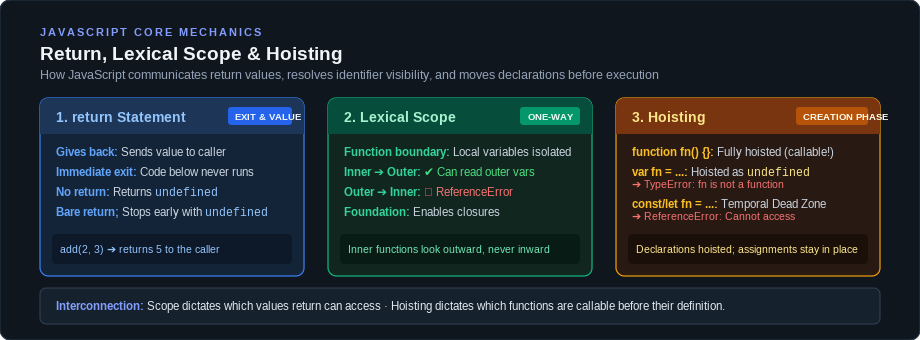
1. The return Statement
The return statement sends data back to the caller and immediately terminates function execution.
Key Rules:
- Immediate Exit: Any code written after a
returnstatement is unreachable and will never execute. - Returning Without a Value: A bare
return;stops execution and yieldsundefined. - Default Return: If a function finishes without encountering a
returnstatement, JavaScript returnsundefinedautomatically.
// 1. Basic Return
function add(a, b) {
  return a + b;
}
console.log(add(2, 3)); // Output: 5

// 2. Return ends function immediately
function test() {
  console.log("A");
  return "Stop here";
  console.log("B"); // Never runs (unreachable code)
}
console.log(test()); // Output: "A", "Stop here"

// 3. Return without a value
function hello() {
  return;
}
console.log(hello()); // Output: undefined2. Function Scope & Lexical Scope
Every function creates its own scope boundary. Variables declared inside a function (let, const, var) are private to that function and cannot be accessed from the outside.
The One-Way Rule of Lexical Scope
- Inner can access Outer: Inner functions can look up the scope chain and read variables from parent scopes. This is the foundation of closures.
- Outer cannot access Inner: Parent functions have zero access to variables declared inside child functions.
// 1. Function Scope (Private variables)
function demo() {
  let x = 10;
  console.log(x); // 10
}
demo();
// console.log(x); // ❌ ReferenceError: x is not defined

// 2. Inner functions access outer variables (Lexical Scope)
function outer() {
  let value = 42;
  function inner() {
    console.log(value); // 42 (looks outward!)
  }
  inner();
}
outer();

// 3. Outer CANNOT access inner variables
function run() {
  let a = 5;
  function inside() {
    let b = 10;
    console.log(a); // 5
  }
  inside();
  // console.log(b); // ❌ ReferenceError: b is not defined
}
run();3. Hoisting in Functions
Hoisting is the browser engine's behavior of allocating memory for variable and function declarations during the compile/creation phase, before code runs line-by-line.
How functions hoist depends entirely on how they are defined:
// Type 1: Function Declarations (Fully hoisted with body)
greet(); // Output: "Hello!" (Callable before its definition!)

function greet() {
  console.log("Hello!");
}

// Type 2: Function Expressions using var
// sayHi(); // ❌ TypeError: sayHi is not a function
var sayHi = function () {
  console.log("Hi");
};

// Type 3: Function Expressions using let / const
// hello(); // ❌ ReferenceError: Cannot access 'hello' before initialization
const hello = function () {
  console.log("Hello");
};
Function Type | Syntax | Hoisted? | Callable Before Definition? | Early Invocation Error |
|---|---|---|---|---|
Function Declaration | function greet() {} | Yes (Name & Body) | Yes | None (Works seamlessly) |
Function Expression (var) | var greet = function() {} | Variable name only | No | TypeError: greet is not a function |
Function Expression (let/const) | const greet = () => {} | Name in Temporal Dead Zone | No | ReferenceError: Cannot access before initialization |
Think it throughClassic Interview Challenge: What does this output and why?
var foo = 1;
function bar() {
  if (!foo) {
    var foo = 10;
  }
  return foo;
}
console.log(bar());
Output: 10
Why?
Inside bar(), var foo is hoisted to the top of the function scope initialized as undefined. When if (!foo) evaluates, foo is undefined, so !undefined evaluates to true! The assignment foo = 10 executes, and return foo returns 10.
Quick Recap & Interconnections
- 🔹 Scope controls return: The function's lexical scope determines which variables
returncan access and compute. - 🔹 Hoisting determines call order: Function declarations can be organized with caller first and helper implementations below; function expressions must be defined before use.
- 🔹 Lexical scope enables closures: When an inner function is returned, it preserves access to its parent scope variables across time.